
Getting poor surface finishes, dimensional inaccuracies, or burn marks on your parts? The problem often isn’t the machine but the grinding wheel itself. Choosing the wrong one can scrap expensive materials and cause major production delays, hurting your bottom line and reputation.
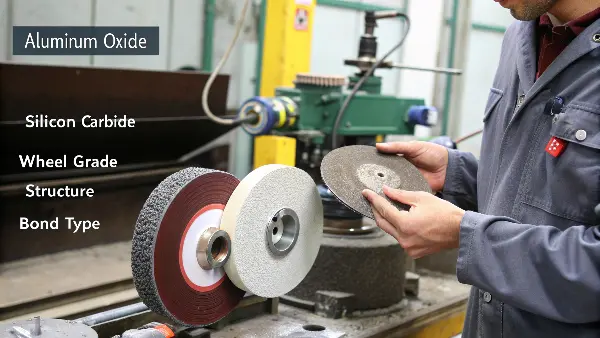
To select the right grinding wheel for centerless operations, you must match five key specifications to your workpiece material and desired outcome. These are the abrasive type, grit size, wheel grade (hardness), structure, and bond type. For example, use an aluminum oxide wheel for steel and a silicon carbide wheel for cast iron, adjusting grit and grade for finish and material hardness.
I remember working with a client, let’s call him Alex, who was struggling with a high-precision shaft project. His team was experiencing inconsistent results, and their scrap rate was through the roof. He sent me some photos, and I suspected the issue was their grinding wheel selection. It’s a common problem, but one that is solvable with the right knowledge. Getting this right seems complex, but it’s a logical process once you understand the language of grinding wheels.
Let’s break it down step by step, so you can make the right choice every time.
What are the specifications of a grinding wheel?
Have you ever looked at a grinding wheel and felt overwhelmed by the string of letters and numbers printed on it? This code seems cryptic, but ignoring it can lead to choosing a wheel that damages your workpiece or wears out too quickly, wasting both time and money.
A grinding wheel’s specifications detail its five core characteristics: abrasive type, grit size, grade (hardness), structure (density), and bond type. This standardized code tells you exactly what the wheel is made of and how it’s designed to perform, helping you match it to your specific grinding job for optimal results.
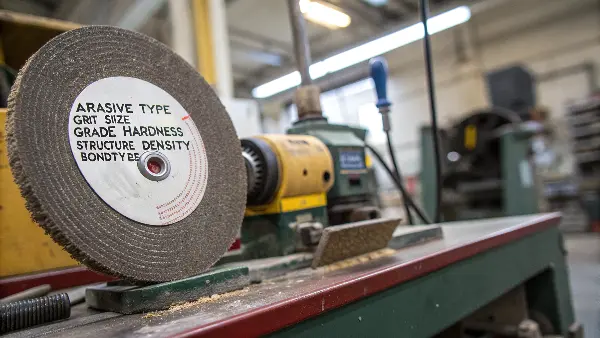
To really master centerless grinding, you have to speak the language of the wheel. These specifications are not just random numbers; they are the recipe for the tool you are using. Understanding them is the first step toward predictable and high-quality results. I always tell engineers that a grinding wheel isn’t just a simple tool; it’s a complex consumable with thousands of cutting points. Let’s look at what each part of that recipe means.
The Five Key Characteristics
These five elements work together to determine a wheel’s cutting action, lifespan, and the finish it produces.
-
Abrasive Type: This is the material doing the cutting. Common types include Aluminum Oxide (A) for general-purpose steel grinding, and Silicon Carbide (C) for non-ferrous metals like aluminum and brass, as well as cast iron. For harder superalloys, you might need Ceramic Alumina (SG) or a superabrasive like Cubic Boron Nitride (CBN).
-
Grit Size: This number indicates the size of the abrasive grains. A lower number (e.g., 24) means coarse grains for rapid material removal. A higher number (e.g., 120) means fine grains for a smooth surface finish.
-
Grade (Hardness): This letter (from A for soft to Z for hard) represents the hardness of the bond holding the abrasive grains. It’s a bit counterintuitive: you use a soft-grade wheel for hard materials and a hard-grade wheel for soft materials.
-
Structure: This number indicates the spacing of the abrasive grains. A low number (e.g., 4) means a dense structure, good for holding form. A high number (e.g., 12) means an open structure, which provides better chip clearance and cooling.
-
Bond Type: This is the "glue" holding the wheel together. The most common is Vitrified (V), a hard, strong bond for precision grinding. Resinoid (B) is tougher and better for high-speed, heavy-duty work.
How do you read a grinding wheel specification?
Do you find yourself guessing what the code on a grinding wheel means? This uncertainty can lead you to use a wheel that’s too aggressive or too fine, causing chatter, burning, or a poor finish. Without a clear understanding, you’re essentially grinding in the dark.
To read a grinding wheel specification, you decode the sequence of letters and numbers. For example, a wheel marked A46-H8V means: A is Aluminum Oxide abrasive, 46 is the medium grit size, H is the soft grade, 8 is the standard structure, and V is the Vitrified bond. Each position in the code identifies a specific characteristic of the wheel.
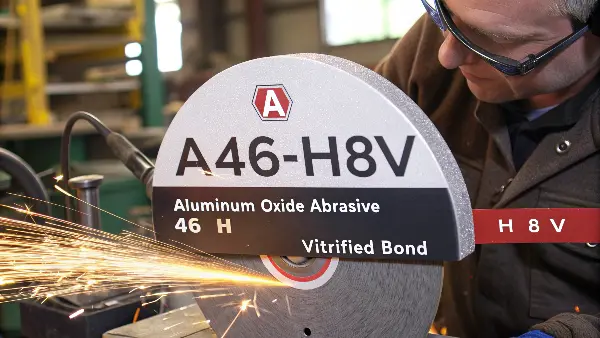
I once had a new operator in my shop who was struggling with a job. He grabbed a wheel that "looked right" and ended up with burn marks all over his parts. The problem was he used a wheel with a hard grade on a hardened steel shaft. He didn’t know how to read the code. We walked through it together, and it was a lightbulb moment for him. Let’s decode this together, using a standard example and a table to make it simple.
Decoding the Standard Marking System
The code on a grinding wheel is not random; it follows a predictable industry standard. While manufacturers might add their own prefix or suffix, the core sequence remains consistent.
Let’s break down a typical specification: WA 60 K 5 V BE
| Position | Code | Meaning |
|---|---|---|
| Prefix | WA |
Manufacturer’s Abrasive Symbol. The ‘W’ is a manufacturer-specific prefix, often indicating a variation. ‘A’ stands for Aluminum Oxide. So, "WA" is typically White Aluminum Oxide. |
| 1. Grit Size | 60 |
Medium Grit. This number indicates the abrasive grain size. It’s in the medium range, providing a good balance between material removal rate and surface finish. |
| 2. Grade | K |
Medium Grade (Hardness). The letter represents the bond’s hardness. ‘K’ is in the middle of the scale (A-Z), offering a versatile balance for many common materials. |
| 3. Structure | 5 |
Medium Dense Structure. This number (typically 0-16) describes the grain spacing. ‘5’ is a relatively dense structure, good for form holding and achieving a fine finish. |
| 4. Bond Type | V |
Vitrified Bond. This is the most common bond type, known for its rigidity, strength, and resistance to oils and coolants. It’s ideal for precision grinding applications. |
| Suffix | BE |
Manufacturer’s Symbol. This is an optional code used by the manufacturer to denote a specific modification to the bond or other property. It’s not part of the universal standard. |
By learning this sequence—Abrasive, Grit, Grade, Structure, Bond—you can quickly assess any wheel’s intended purpose. This knowledge is not just academic; it’s a practical skill that prevents costly mistakes and empowers you to optimize your grinding processes.
How do you select the correct grinding wheel for a specific material?
Are you unsure how to match a grinding wheel to your workpiece? Picking the wrong combination can lead to problems like wheel loading, glazing, or burning the material. This trial-and-error approach is inefficient and can ruin expensive components, especially when working with tough alloys or tight tolerances.
To select a wheel for a specific material, start with the material’s hardness and tensile strength. Use Aluminum Oxide (A) for steels and Silicon Carbide (C) for cast iron and non-ferrous metals. For hard materials, use a softer grade wheel (G, H) and a coarser grit. For soft materials, use a harder grade wheel (K, L).
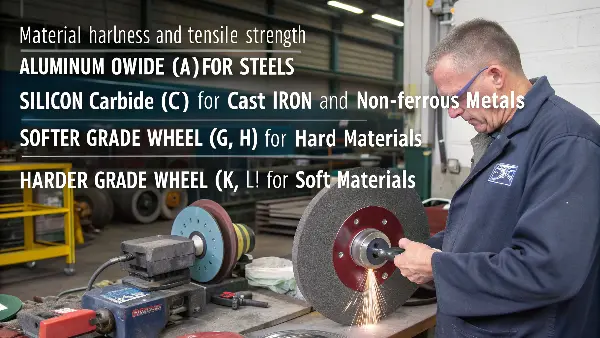
This is where theory meets practice. The client I mentioned, Alex, was grinding a hardened tool steel (around 60 HRC). His team was using a harder grade wheel, thinking "hard material needs a hard wheel." This is a common mistake. The hard wheel couldn’t break down to expose new sharp grains, so it just rubbed and generated heat, causing the burn marks. We switched to a softer grade (H) White Aluminum Oxide wheel, and the problem vanished. The wheel started "self-sharpening" correctly, cutting coolly and efficiently.
A Practical Guide to Material-Based Selection
Let’s break down the selection process based on common material groups. The key is the interplay between the material properties and the wheel’s grade and abrasive type.
Guideline 1: Match Abrasive to Material Type
The first decision is always the abrasive.
- High Tensile Strength Materials (Steels, Tool Steels, Alloy Steels): Use Aluminum Oxide (A) or its variations like White Aluminum Oxide (WA) or Pink Aluminum Oxide (PA). For very hard, heat-sensitive steels or superalloys, a Ceramic Alumina (SG) or Cubic Boron Nitride (CBN) wheel is best.
- Low Tensile Strength Materials (Cast Iron, Aluminum, Brass, Copper): Use Silicon Carbide (C). Its grains are harder and sharper than aluminum oxide, which is ideal for penetrating these materials.
- Extremely Hard Materials (Carbide, Glass, Ceramics): Use a superabrasive like a Diamond (D) wheel.
Guideline 2: Match Wheel Grade to Material Hardness
This is the most critical and often misunderstood step.
- Hard Materials (e.g., Hardened Tool Steel, Carbides): Use a Soft Grade Wheel (F, G, H). The hard material will easily dull the abrasive grains. A soft bond allows these dull grains to break away, exposing fresh, sharp grains underneath. This is the "self-sharpening" action you want.
- Soft Materials (e.g., Mild Steel, Aluminum): Use a Hard Grade Wheel (K, L, M). Soft, gummy materials can rip abrasive grains from a soft bond prematurely. A harder bond holds onto the grains longer, maximizing wheel life and cutting efficiency.
The goal is to create a balanced system where the wheel wears just enough to stay sharp but not so much that it loses its form or wears out too quickly.
What is a Type 5 grinding wheel?
Have you ever ordered a grinding wheel only to find it doesn’t fit your machine or provide the clearance you need? The shape, or "Type," of a grinding wheel is a critical specification that is often overlooked, leading to setup issues, interference with the workpiece, and wasted time.
A Type 5 grinding wheel is a straight wheel with a recess on one side. This recess allows the wheel to fit over the machine’s flange and spindle nut, providing more clearance. It is commonly used in applications like surface grinding and cutter sharpening where space is tight and you need to grind close to a shoulder or adjacent surface.
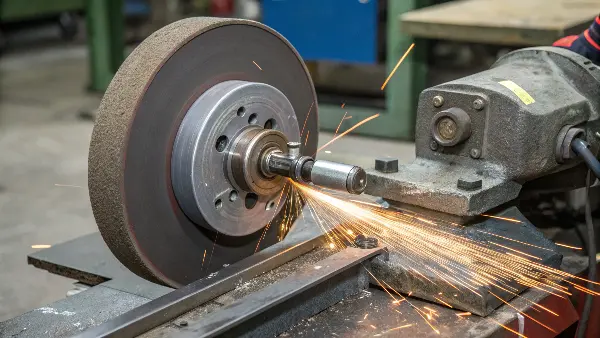
In centerless grinding, the wheel shape is fundamental to the entire setup, but beginners often focus only on abrasive and grit. I remember a project where we needed to grind a short shaft with a large head. A standard Type 1 straight wheel would have interfered with the workpiece. We switched to a Type 7 wheel, which has recesses on both sides, allowing the regulating wheel and blade to support the part properly. Wheel shape isn’t just about fitting the machine; it’s about enabling the grinding operation itself. While Type 5 is a specific example, it’s part of a larger system of wheel shapes designed for different tasks.
Common Wheel Shapes for Precision Grinding
The shape of the grinding wheel is designated by a number. For centerless grinding, the main grinding wheel is typically a straight wheel, but the specific type matters for clearance and mounting.
| Wheel Type | Description | Common Applications in Precision Grinding |
|---|---|---|
| Type 1 | Straight Wheel. A simple, flat disc shape with the grinding face on the periphery. | The most common shape for centerless, cylindrical, and surface grinding. Used for grinding flat surfaces and simple diameters. |
| Type 5 | Recessed One Side. A straight wheel with a recess on one side. | Used when extra clearance is needed for the mounting flange on one side. Good for getting close to shoulders or corners. |
| Type 7 | Recessed Both Sides. A straight wheel with recesses on both sides. | Provides maximum clearance for flanges on both sides. Often used in centerless and cylindrical grinding setups for this reason. |
In centerless grinding, the main grinding wheel is almost always a Type 1, 5, or 7.
- Grinding Wheel: A large Type 1 wheel is the standard. However, Type 5 or 7 wheels are used to accommodate large-diameter flanges, which are necessary for safe operation at high speeds. The recesses provide the clearance needed for the mounting hardware.
- Regulating Wheel: The regulating wheel, which controls the workpiece’s rotation speed, is also typically a Type 1 wheel, but made of a rubber or resinoid bond to provide friction.
Choosing the right wheel shape is a foundational step. It ensures the wheel not only fits the machine’s arbor and flanges but also functions correctly within the geometric constraints of your specific grinding setup. Always check your machine’s manual and the operational requirements before ordering.
Conclusion
In summary, selecting the right grinding wheel is a systematic process. By understanding wheel specifications, material interactions, and shapes, you can eliminate guesswork, improve quality, and enhance your manufacturing efficiency.